What the Mantuan Melon PGI is, exactly
Every summer somebody asks us whether “PGI” is a variety of melon. It isn’t. It is, more or less, an address.
PGI stands for Protected Geographical Indication (IGP in Italian). It is a European recognition that certifies neither a recipe nor a single seed: it certifies that a product comes from a specific place, and that the place has something to do with how the product turns out. In the case of the Mantuan Melon PGI (Melone Mantovano IGP), the place is the plain between the Po and the Oglio, in the province of Mantova. We are at Viadana, on the southernmost edge of that plain, where the Po stops being Lombardy and becomes the border with Emilia.
So no: there is no such thing as “the Mantuan melon seed”. There are types (the smooth and the netted) grown to a set of production rules, within a defined area, with verifiable quality characteristics. The mark guarantees the geographical origin and those characteristics. It does not guarantee that the melon in your hands will be to your liking: that, honestly, also depends on who grew it and on when it came off the plant.
Why here: the Oglio-Po plain
There is a reason this strip of plain has been producing melons for centuries, and it is not marketing. It is the soil.
Po silt, laid down by centuries of floods, has built ground that is sandy, deep and free-draining, with a pH that cucurbits get on with. It is ground that does not hold water and does not waterlog: the melon root, which loathes standing water, works well in it. We sit at 22 metres above sea level: low alluvial plain, no slopes, no rock, no geological surprises.
Then there is the climate. The Po Valley summer is long and hot, often muggy. But the nights, here close to the river, cool down. That day-to-night temperature swing is the real secret behind the sugars. By day the plant accumulates; by night it slows its respiration and does not burn off what it has accumulated. The result goes straight into the degrees Brix, which we come to further down.
Rainfall is modest: the historic average for the Mantova area is around 650 mm a year, concentrated outside the season. Which means that in summer the water has to be put on, and put on with judgement, because on sandy soil what you give today has already drained away by tomorrow.
And then there is the fog. In autumn the damp of the river country is not a picturesque nuisance: it slows the water loss of the fruit in the final phase and helps concentrate the flesh. For our squash it is decisive. For the melons it arrives too late, but it tells you rather well what kind of place this is.
We are not the first to notice. The Gonzagas kept their leisure gardens here five hundred years ago, not for the beauty of the landscape, but because the land paid.
The farmer does not make the melon. The land makes it. The farmer, at best, avoids ruining it.
The two types: smooth melon and netted melon
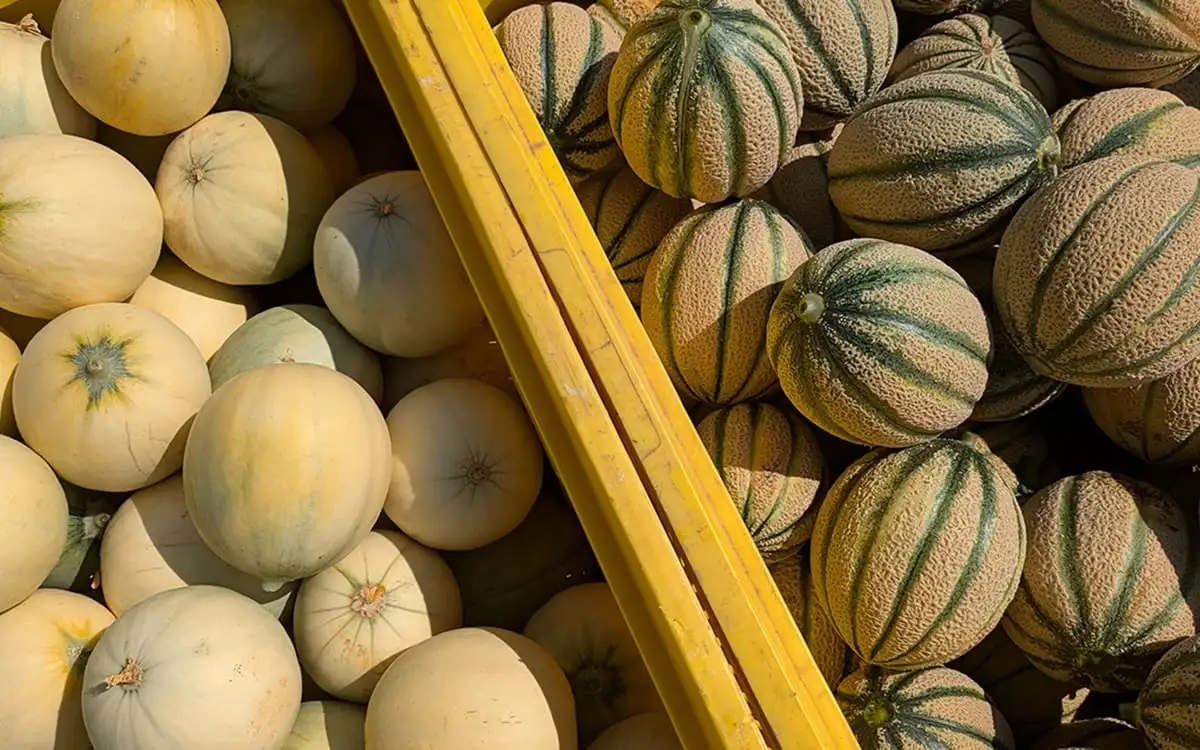
Two types are grown in the Mantova area, and they really are different. They are not two trade names for the same thing: the skin, the flesh, the scent and the keeping quality all change, and with them the use.
The smooth melon
The skin is smooth, not netted, cream-yellow with green shading, 8–12 mm thick. Thin, but tough enough to take transport. This is the melon you recognise from the other end of the counter: even surface, delicate colour.
The stalk is short, 2–4 cm, greenish-beige, sturdy. At full ripeness a natural split forms at its base, what we call slip out in the field. That is the signal that the fruit is ready: the calendar does not decide it, the plant does.
The flesh is a deep golden orange, 4–5 cm thick, juicy and melting, with no coarse fibre. The scent is persistent, with floral and musky notes. The seeds (golden, spindle-shaped, between 200 and 350 per fruit) all sit in the small central cavity.
On sugar content the smooth reaches 14–17 °Brix, with peaks of 18. It is the type that, on average, goes past 16 most often.
The netted melon
Here everything changes, starting with the surface. The skin is covered by a dense fibrous net (the netting) in grey-green, with pronounced ribbing, and it is thicker: 10–15 mm. That net is not a cosmetic flourish. It is a sign of advanced ripening, and it works as a natural armour that protects the flesh in storage.
The stalk is short and stubby, brownish-green, and here too the slip appears at ripeness: the split at the base that says, without ambiguity, that the fruit has reached its aromatic peak.
The flesh is an intense, bright orange, dense, juicy and almost free of fibre, 3–5 cm thick. The scent is the signature of the Mantuan netted melon: musky and persistent, the kind of aroma you get before you cut. The seeds are whitish and spindle-shaped, 250–400 per fruit.
On sugar content the netted reaches 14–18 °Brix, with peaks of 19 in the hotter seasons on the Oglio-Po plain.
So which of the two
It depends what you need it for.
The smooth has a more immediate, cleaner sweetness, flesh that dissolves, a more floral scent. It suits anyone who wants melon at the end of a meal, cold, cut into wedges.
The netted is more complex: a more intense and persistent aroma, denser flesh, a thick skin that holds it together for longer. It is the melon that stands up better to a savoury pairing (ham, fresh cheeses) and that lasts longer once it is home.
Degrees Brix, and why we go on about them
Degrees Brix (°Bx) measure the concentration of soluble sugars in the flesh: sucrose above all, then fructose and glucose. One degree Brix corresponds, in practice, to one per cent of dissolved sugars. It is the number technicians use instead of the adjective “sweet”, because the adjective cannot be compared and the number can.
Our melons sit between 14 and 18 °Brix. For a sense of scale: above 14 you are in sweet, aromatic melon territory, and the higher it goes the longer the fruit was left to ripen on the plant.
The important point, and the most misunderstood, is this: a melon accumulates no more sugar after harvest. Unlike a pear or a banana, it has no starch reserve to convert. It carries on ripening (the flesh softens, the aroma develops, the scent comes out), but the degrees Brix it had when it came off the plant are the degrees Brix you get on the plate. Full stop.
Everything else in our work follows from that. There is no fixing an early harvest. That is why we monitor ripening in the field instead of picking everything in one go, and why we pick in successive passes: you go over the same plot several times, and each time you take only what is ready. It is slower, it costs more, and it is the only thing that works.
Long Shelf Life: what it actually means
All the varieties we grow are classified Long Shelf Life (LSL). It is a phrase that sounds vaguely industrial and deserves an explanation, because it is regularly taken to mean the opposite of what it means.
LSL does not mean “treated to last”. It means the variety holds up longer after harvest by genetics: the flesh stays firm for longer, the skin protects better, the fruit does not collapse after three days. In the netted melon, the thick netted skin does most of that work on its own, which is why the netted holds its high sugar content well after harvest.
Why do we care? Because between our field and somebody’s table there are, inevitably, some days. An LSL variety is what allows a melon picked ripe to reach the other end of Italy still intact. The alternative, picking unripe to buy days of transport, is exactly what we have just explained we do not want to do.
How to tell whether a melon is ripe
A few practical pointers, good both in the field and in front of the counter.
The stalk. First place to look. If there is a natural split at the base (the slip), the fruit came away on its own because it was ready. If instead the stalk is cut clean, with a piece of stem still attached, somebody decided in the plant’s place.
The scent. A ripe melon is smelled at the end opposite the stalk. If it smells of nothing, it will not smell of anything later either. If it smells too much, and of alcohol, it has gone past.
The netting, on the netted melon. A dense, raised, even net: advanced ripeness. A sparse, flattened net: not there yet.
The background colour, on the smooth melon. The green must have given way to cream-yellow. A smooth melon that is still frankly green is a smooth melon picked early.
The weight. At equal size, the heavier one is the one with more water and more flesh. It is the oldest trick in the book and it is still the best.
What does not work is knocking on the melon and listening to the sound. That works for watermelon. On a melon, with the thick skin of the netted type, you get more or less the same noise at any stage.
The year: how a melon comes about, January to September
Winter. Nothing to see in the fields, and the work goes on all the same: soil analysis, planning the rotations, choosing the varieties, maintaining the structures. Crop rotation is not an ideological detail: it is the precondition for the natural resistance of the crops. Soil that has had melon on it five years running is no longer soil, it is a problem.
Spring. The seedlings are prepared and transplanted. Part of the production goes under the tunnel greenhouses, which give us a few weeks’ head start and shelter the crop from late frosts and from hail, which here, in April, is not a theoretical possibility. The rest goes into the open field, on a longer timescale and over a larger area.
Summer. This is the season in which the melon decides what it will be. You manage the water (little and often, on these soils), you keep an eye on the health of the crop, you wait. Then you start going over the rows, and picking.
Harvest runs from May to September, in successive passes: the tunnel fruit opens, the open field follows, and each pass takes only the fruit that has reached its peak. During harvesting the same row is gone over several times in the course of the week.
Autumn. The melons are done, it is the turn of the squash, which we harvest here from September to November, and then of the soil: land work, amendments, rest.
Where the melon we pick ends up
One thing needs saying plainly here, because we get asked often.
We do not sell to the public. We have no farm shop, we have no online shop, we do not post boxes. We are members of the Agricola Don Camillo cooperative and we deliver our entire production to it.
This is not a choice made for an easy life. A cooperative does three things a single family farm of 25 hectares cannot do on its own: it sets and checks uniform quality standards, it aggregates enough volume to stand on serious markets, and it protects the grower from negotiating one against one with the distribution chain. In exchange, it asks you to stay inside those standards. That suits us, and it is nothing new: the cooperative world is the setting in which this area has produced melon for decades.
From there the melon enters the supply chain: wholesale fruit and vegetable markets, large-scale retail and retailers across Italy. Which is, in the end, why Long Shelf Life counts.
A historical note: the Melone d’Oro
The reputation of the Viadana melon did not begin with the PGI. By 1996 the area had been hosting a competition for years, the Melone d’Oro (Golden Melon), in which a jury of technicians from the experimental institutes and the fruit and vegetable markets judged the melons of local farms: aesthetic parameters, firmness of the flesh, sugar content, organoleptic characteristics.
That year we won it, for the second consecutive time, against thirty-one competing farms. We told the story (with the newspaper cuttings of the day) here: 1996, the second Golden Melon of Viadana.
Frequently asked questions about the Mantuan Melon PGI
Where do you buy Mantuan melon?
We do not sell direct to the consumer: we have neither a shop nor an e-commerce site. Our entire production is delivered to the Agricola Don Camillo cooperative, of which we are members, and from there it enters the supply chain: wholesale markets, large-scale retail and retailers across Italy.
In practice, Mantuan melon is found on fruit and vegetable counters during the season (May to September), and it is worth asking the greengrocer where it comes from, because “melon” and “Melone Mantovano IGP” are not synonyms.
How much does Mantuan melon cost?
We cannot tell you, and that is an honest answer rather than a rude one: we do not set the retail price. We deliver the fruit to the cooperative, and from that point on the price forms along the supply chain according to the season, the sizes, the volumes available and the sales channel.
What we can say is that the price varies a great deal over the season (the fruit at the start of harvest, the tunnel fruit, is structurally dearer than main-season fruit) and that a PGI-certified melon picked ripe does not cost what a generic melon picked unripe costs. It should not, at any rate.
When is the Mantuan melon season?
May to September, picked in successive passes. It starts with the fruit from the tunnel greenhouses, which comes a few weeks early, and carries on with the open field. Outside that window, a melon on sale in Italy comes from another hemisphere or another latitude: perfectly legitimate, but it is a different product.
What is the difference between PGI and PDO?
They are two European recognitions that differ in how tightly the product is bound to its territory. Under PDO (Protected Designation of Origin, DOP in Italian) all the stages (production, processing, preparation) must take place inside the defined area. Under PGI (Protected Geographical Indication, IGP in Italian) it is enough that at least one of those stages happens there, and what is protected is the link with the reputation and the characteristics of the area. The Melone Mantovano is a PGI.
Smooth melon or netted melon?
They are two different products. The smooth has a thin skin, melting golden-orange flesh, a floral scent and an immediate sweetness: it regularly goes past 16 °Brix. The netted has a thick netted skin, denser flesh, a more persistent musky aroma, and it keeps better over time.
Rule of thumb: smooth to eat straight away and on its own, netted if you want character, or if you are pairing it with something savoury.
How sweet is a Mantuan melon?
Ours sit between 14 and 18 °Brix, with peaks of 19 on the netted in the hotter seasons. Above 14 °Brix you are talking about a sweet, aromatic melon. Remember that the figure is fixed at the moment of harvest: a melon does not get sweeter once it is in your kitchen, it only gets softer and more fragrant.
How do you keep a melon?
Whole, it is perfectly happy at room temperature until it comes to the right point: the fridge switches the aroma off, and a melon with a few days still ahead of it only loses by going in there. Cut, on the other hand, it goes in the fridge covered, and it should be eaten within a couple of days.
A netted melon, thanks to its thick skin, forgives a few more days than a smooth one.
Is the Mantuan Melon PGI organic?
No, and they are two distinct things. The PGI certifies the geographical origin and the quality characteristics of the product; organic certifies the production method. A product can be one, the other, both or neither. They are marks that answer different questions, and it is worth not confusing them when you read a label.
If you have got this far, melon probably interests you more than average. For anything at all (curiosity, enquiries, objections) we are here.